

How a Commercial Painting Company Can Transform Your Office
Hiring a commercial painting company can do more than refresh your walls — it can boost employee morale, sharpen your brand perception, and create a more welcoming environment for both staff and clients. And in today’s competitive commercial real estate market, where commercial vacancy costs are rising an average of 2–3% annually across major U.S. metros, the visual condition of a space has never mattered more.
Whether you’re a business owner looking to reinvigorate your team, a facility manager planning a scheduled refresh, or a building owner trying to attract and retain quality tenants, this guide covers everything you need to know about what a professional commercial paint job can do — and how to choose the right company to deliver it.
Benefits of Updating Your Office
A fresh paint job is one of the highest-ROI improvements a business can make to its physical space. The benefits extend well beyond aesthetics — they touch employee experience, client perception, and the bottom line.
- Happier employees. The physical environment where people spend 40+ hours a week has a direct impact on how they feel at work. Dull, outdated, or poorly maintained spaces signal that the organization doesn’t invest in its people — and employees notice.
- Boosted productivity. Color psychology research consistently shows that strategic color choices can measurably affect focus, energy, and output. More on this below.
- Better client perception. Clients and visitors form opinions about a business within seconds of entering the space. A well-maintained, cohesive office communicates professionalism, attention to detail, and organizational health before a single word is spoken.
- Cohesive branding. Your office is a physical expression of your brand. Color, finish, and design consistency across your space — and across multiple locations — reinforces brand identity in a way that’s immediate and visceral.
- Tenant attraction and retention. For commercial building owners, a well-maintained, freshly painted space is one of the most cost-effective ways to reduce vacancy periods, command stronger rental rates, and attract stable, long-term tenants.
How Can an Office Paint Job Impact Productivity?
The connection between physical environment and workplace performance is well-documented, and paint color is one of the most accessible levers a business can pull.
A University of Texas study found that paint colors have a measurable impact on mood and productivity. Notably, the gray and beige palettes found in most offices can actually induce feelings of sadness and low energy — the opposite of what most organizations want from their workspace. Meanwhile, Gallup research shows that engaged employees are 17% more productive than their disengaged counterparts, and the physical environment is consistently cited as a key driver of engagement.
Here’s how specific color families perform in a workplace context:
Blue
Blue is the most widely recommended color for focus-intensive work environments. It’s associated with calm, stability, and sustained concentration — which is why it dominates the branding of companies like IBM, Samsung, and JPMorgan Chase. In workspaces where deep focus is the priority, blue tones on the walls support the kind of sustained attention that productivity requires.
Green
Green is calming on the eyes and associated with balance and well-being. It’s particularly effective in environments where employees spend long hours at screens, and it performs well in spaces that benefit from a natural, grounding atmosphere — wellness rooms, break areas, and collaborative zones.
Yellow
Yellow stimulates creativity and optimism, making it a strong choice for brainstorming spaces, creative studios, and innovation hubs — but it should be used as an accent rather than a primary wall color to avoid overstimulation.
Red
Red increases energy and adrenaline, which makes it useful in small doses for high-energy environments like gyms or sales floors — but too much red in a focused work environment creates tension and fatigue.
White or Soft Neutrals
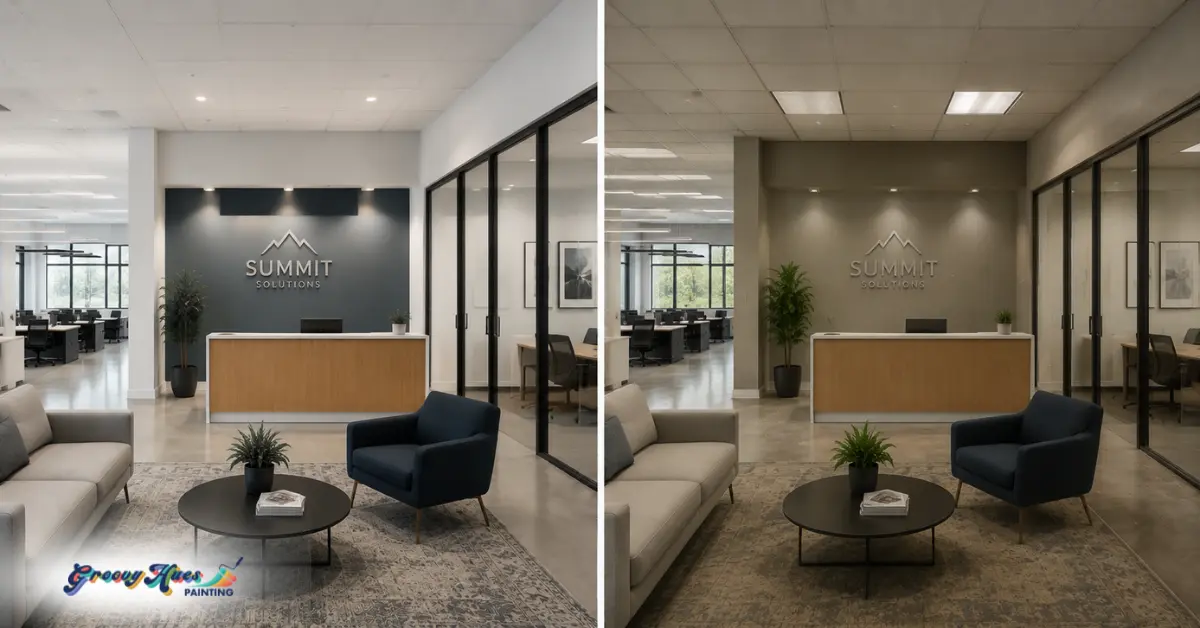
White and light neutrals like greige or ivory remain popular for maximizing perceived space and light, but used exclusively, they can feel sterile and uninspiring. Pairing a neutral base with strategic accent colors in specific zones creates an environment that supports different modes of work throughout the day.
The bottom line: the colors your employees look at all day aren’t neutral. Choosing them intentionally, with guidance from a commercial painting company that understands color psychology, is one of the lowest-cost, highest-impact workplace investments available.
Are you ready for an office transformation? Call Groovy Hues, send us a message online, or find a commercial interior painting contractor near you.
How Does Painting Tie into Branding and Company Culture?
Your office tells a story about your organization before anyone reads your website or shakes your hand. The colors, finishes, and overall condition of your space communicate values — whether you intend them to or not.
Brand color alignment.
Incorporating your brand’s primary and secondary colors into your office environment creates immediate visual consistency between your physical space and your digital identity. For client-facing areas — reception, conference rooms, showrooms — this coherence reinforces brand recognition and professionalism. It tells visitors they’re in the right place.
Cross-location consistency.
For businesses with multiple offices or franchise locations, visual consistency across all spaces is a brand asset. A commercial painting company with multi-location experience can ensure that your color palette, finish specifications, and application quality are consistent from one location to the next — so that every office feels like the same company.
Culture through design.
The aesthetic character of a space signals the culture of the organization that inhabits it. A sleek, monochromatic palette in dark neutrals communicates sophistication and precision — well-suited to law firms, financial services, and architecture studios. A warm, earthy palette with eclectic accent walls communicates creativity and accessibility — better suited to agencies, tech startups, and design firms. A bright, high-contrast space with energetic colors signals dynamism and enthusiasm. Getting this alignment right requires both color expertise and an understanding of the brand, which is why a professional consultation is worth the time.
Can a Commercial Paint Job Attract Tenants?
For building owners and property managers, the ROI calculus on commercial painting is compelling. According to the National Association of Realtors, commercial vacancy rates stand at around 13.7% — and in that environment, the visual condition of a space is a direct competitive differentiator.
Research from CBRE Group shows that well-maintained commercial properties lease 30–45 days faster than comparable properties in dated condition. According to CoStar Group data, properties in excellent condition lease 40% faster than those in average condition, with paint being the most visible condition indicator. Fresh paint supports 3–7% higher rental rates, and updated interiors can increase commercial property sale prices by 5–10%.
The math is straightforward: vacancy costs money every day. A professional paint job that reduces vacancy time by even two to three weeks pays for itself many times over — before accounting for any rental rate premium. And vacancy costs are rising an average of 2–3% annually across major U.S. metros, making the case for well-maintained properties stronger every year.
A freshly painted commercial space also signals something less quantifiable but equally important: that the property is professionally managed. Prospective tenants — especially in technology, finance, and professional services — choose spaces that reflect their own brand values. A space that looks cared for attracts tenants who will care for it in return.
Why Should You Hire a Professional Commercial Painting Company?
The scale, complexity, and stakes of a commercial paint job are fundamentally different from a residential project. Here’s what professional execution delivers that DIY or low-cost alternatives can’t.
-
Consistency at scale.
A commercial space may involve thousands of square feet across multiple rooms, floors, or buildings. Achieving consistent color, finish, and coverage across that scale requires professional equipment, disciplined application technique, and project management — not just a large crew with rollers.
-
Minimal disruption to operations.
A reputable commercial painting company works around your schedule — whether that means nights, weekends, phased sections, or accelerated timelines to reduce downtime. They also manage the logistical realities of painting in an occupied space: odor control, drying time, protecting furniture and equipment, and ensuring the space is usable as quickly as possible.
-
Safety standards and insurance.
Commercial painting involves working at height, managing paint and solvent disposal, and operating in environments that must meet OSHA standards. A licensed, insured commercial painting company carries general liability and workers’ compensation coverage — protecting both their crew and your organization from liability exposure.
-
Long-lasting results.
Professional painters use commercial-grade products and proper prep protocols that produce finishes lasting 5–10 years. Cutting corners on prep — which is the most common failure point in DIY and budget commercial jobs — leads to peeling, bubbling, and repaints within a fraction of that timeframe.
Groovy Hues’ commercial painting services are designed specifically for these demands — bringing the project management, product knowledge, and application quality that commercial spaces require.
What Prep Work and Planning Go Into a Commercial Paint Job?
A professional commercial paint job starts well before anyone picks up a brush. Here’s what the process looks like with a qualified contractor.
- Initial consultation and color selection. A good commercial painting company begins with a walkthrough to assess surface conditions, discuss goals, review brand guidelines if applicable, and make product and color recommendations. This is the stage where color psychology, finish selection, and budget are all aligned.
- Scheduling around operations. Work schedules are built around your business needs — minimizing disruption to occupied spaces, phasing work across floors or sections, and setting realistic timelines with a buffer for drying and curing between coats.
- Surface preparation. This is where professional results are made or lost. Proper prep includes cleaning surfaces to remove grease, dust, and contamination; repairing cracks, holes, and damaged sections; sanding for adhesion; caulking gaps at trim and transitions; and priming where required. Rushing prep is the single most common cause of early paint failure — and it’s where professional discipline matters most.
- Managing the work environment. Low-VOC and zero-VOC commercial paints have made significant advances in recent years, reducing odor and off-gassing so that spaces can be returned to use quickly. Professional crews also use dust control, floor protection, and air management to minimize the impact on occupied areas.
- Quality control and walk-through. A professional job concludes with a detailed inspection against the scope of work — ensuring coverage is even, lines are crisp, and every surface meets the specified standard before the project is signed off.
How to Choose the Right Commercial Painting Company
Not all commercial painters are equal. Here’s what to look for — and what to watch out for.
What to look for:
- Valid contractor’s license and certificate of insurance (general liability + workers’ comp)
- A portfolio of commercial projects comparable in scale and type to yours
- References from commercial clients — not just residential
- Clear, itemized written estimates with product specifications
- A defined project manager and single point of contact
- Experience with your specific surface types (drywall, masonry, metal, etc.)
- Familiarity with your industry’s specific requirements (healthcare, hospitality, food service, etc.)
Questions to ask during a consultation:
- How will you minimize disruption to our operations?
- What surface prep is included in the scope?
- What products do you specify and why?
- How do you handle unforeseen surface issues discovered during prep?
- What does your warranty cover, and for how long?
- Can you provide references from similar commercial projects?
Red flags to avoid:
- No written contract or vague scope of work
- Unusually low bids that don’t account for prep or primer
- Inability to provide proof of insurance on request
- Pressure to decide quickly or pay a large deposit upfront
- No references, portfolio, or online reviews to verify
Find Groovy Hues’ commercial painting contractors near you for a consultation and free quote. Or give us a call to learn more.
Frequently Asked Questions About Commercial Painting
How often should an office be repainted?
Most commercial interiors benefit from repainting every 3–5 years for high-traffic areas like hallways, reception, and conference rooms, and every 5–7 years for lower-traffic offices.
What colors are best for a calm, focused work environment?
Blue and green are the most research-supported choices for focus and calm in a workplace. Warm neutrals work well as base colors throughout a space, with color used strategically in specific zones.
What colors are trending for commercial buildings this year?
For interiors, warm neutrals, earth tones (terracotta, clay, olive), deep jewel tones (navy, forest green, charcoal), and biophilic greens are dominating commercial design. For exteriors, warm whites and off-whites remain the most broadly appealing choice for tenant attraction, while dark grays, deep blues, and nature-inspired greens are popular for more contemporary commercial buildings seeking to differentiate on the street. Groovy Hues’ exterior painting services and interior painting services cover both.
What paint types are best for high-traffic office areas?
For high-traffic walls, semi-gloss or satin finishes in a commercial-grade washable formula are the professional standard. They hold up to cleaning, resist scuffs and staining, and maintain their appearance significantly longer than flat or eggshell finishes under daily use. For lower-traffic private offices, eggshell or matte finishes provide a more refined, less reflective appearance.
What’s the best time of year to paint an office?
Interior commercial spaces can be painted year-round with proper ventilation. For exterior work, temperature and humidity are the primary constraints — most commercial-grade paints require temperatures between 50–85°F and relative humidity below 85% for proper application and curing. For guidance on cold-weather exterior painting specifically, see Groovy Hues’ article on when it’s too cold to paint outside.
Ready to Transform Your Office? Schedule with Groovy Hues.
A professional commercial paint job delivers more than fresh walls. It creates an environment where employees are more engaged, clients are more impressed, and your brand shows up consistently in the physical space your business occupies. For building owners and property managers, it’s one of the highest-ROI investments available for reducing vacancy and commanding stronger lease rates.
The key is getting it right — with the right colors for your goals, the right products for your surfaces, and the right team to execute it with minimal disruption to your operations.
Call Groovy Hues at (844) 394-8660 to schedule a free commercial consultation, or contact us online. Find your nearest location and let’s talk about what your office could look like.